


When you think of Murano glass, the first word that comes to mind is glassblowing. Blown glass is indeed one of the best-known, most widespread and visually spectacular techniques for creating fine objects and artistic works. This does not mean, however, that Murano glass objects have been made exclusively through glassblowing. In reality, when we talk about blowing we refer to the technique of shaping the object by expanding air inside a molten mass — it is, in short, the embryonic stage, which gives the raw material (glass) a recognisable form (such as an ornament, a chandelier, a vase and so on). But blowing alone is not enough to finish the work and decorate it with unique details. For these steps, other processes are required — and therefore other techniques, the best known of which (because it is often carried out alongside glassblowing) is hammering.

Together, glassblowing and glass hammering are used to bring small and large masterpieces to life, without the addition of polluting chemical substances and without any hazardous material that might disperse into the environment over time (such as VOCs — volatile organic compounds). There are also other techniques for working and decorating glass. We at Ellegi Murano Glass want to guide you through this fascinating world, just as we do during our workshops and live demonstrations. We will reveal the process by which blown glass is shaped through blowing (the hot phase), and how it is then modified through hammering (the cold phase). We will then look one by one at the secondary techniques, such as murrina, filigrana and sommerso. Keep reading and discover the secrets of this beautiful and ancient art!
HOT WORKING AND COLD FINISHING OF GLASS
Blown glass is a shaping technique invented in the 1st century BC (probably in the Syro-Palestinian area) that exploits the viscosity of molten glass to create hollow objects. The person who works the glass — the master glassmaker — introduces air through a blowpipe to expand the mass, obtaining uniform or complex forms (as in the balloton or pigna technique) also with the help of moulds. Hammered glass is instead a cold decorative technique, applied usually to objects that have already been blown or are made of solid glass: the surface is abraded with a grinding wheel to create small irregular “bumps” oriented in the same direction, giving the piece the aesthetic appearance of, for example, wrought iron.
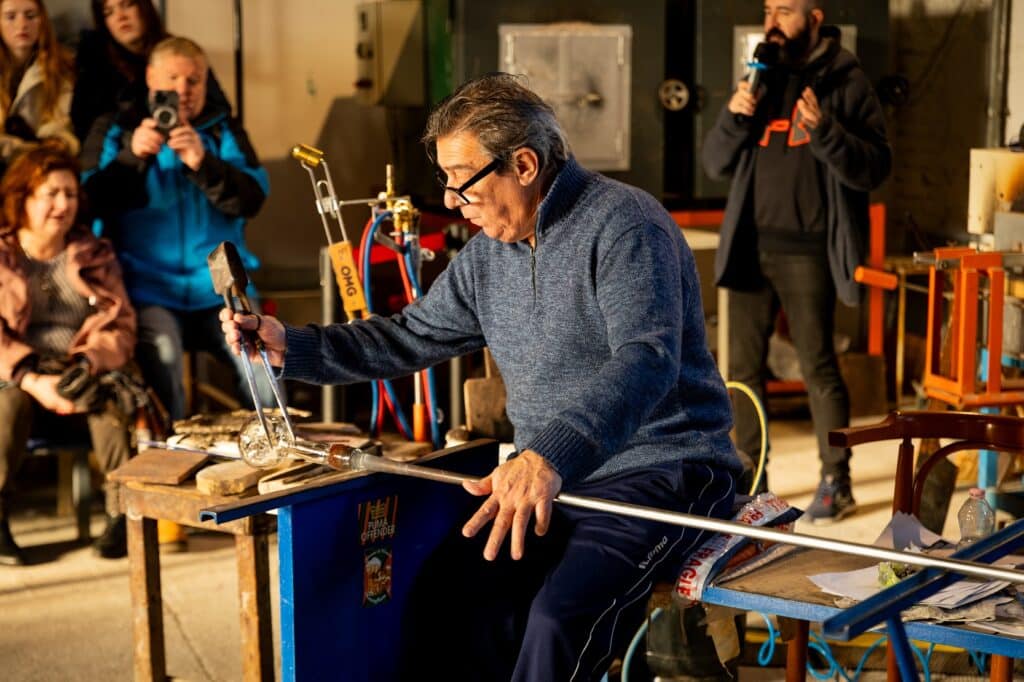
We can broadly distinguish two phases in the working of Murano glass: the hot-working phase — that of blowing, when the glass leaves the furnace and is shaped before it cools — and the cold-working phase, that of hammering (but not only, as we shall see shortly). In our historic furnace in Murano it is possible to admire both phases, with different formats and experiences designed to suit every type of need and audience. Read the details on the experiences page!
1. Blown Glass: The Genesis of Form (Hot Phase)

The glassblowing process, as we have just seen, therefore takes place entirely in the hot phase, specifically at a temperature above 1,000°C. Dedicated furnaces have always been required to reach these conditions and guarantee effective working. But blowing, in addition to being divided into free and mould blowing, is in reality just one of the necessary steps. Let us see how the process unfolds from the gathering of the glass to the actual blowing:
- Gathering: The master glassmaker uses a blowpipe (a metal tube approximately 1.5 metres long) to gather a mass of molten glass from the crucible
- Expansion: By blowing air through the pipe, the glass expands to create a hollow bubble. The viscosity of the material allows the shape to be maintained while it is modelled
- Shaping: The object takes form through the continuous rotation of the pipe and the use of hand tools (pincers, scissors) or moulds. There are two main shaping variants:
1) Free blowing: The shape is created entirely by the glassmaker’s manual skill, without external moulds for the final form.
2) Mould blowing: The partially blown glass is inserted into a mould (metal, wood, clay) that imprints the shape and any relief decorations (as in the pigna or balloton technique).
This technique is the basis for creating hollow objects such as vases, glasses, chandeliers and sculptures, characterised by fluid elegance and the uniqueness of each piece, since every object presents minimal variations impossible to replicate industrially.
2. Hammered Glass: The Sculpture of the Surface (Cold Phase)
The hammered glass is not a method for creating the shape of an object, but rather a refined technique of cold decorative finishing. It is consequently applied to objects and pieces that have already solidified (previously blown or made from solid glass).
The process takes place at room temperature and requires great mechanical precision. The stages it is divided into are as follows:
- Abrasion: The glass surface is worked manually or mechanically using a grinding wheel (often diamond or corundum)
- Texture Creation: The master glassmaker incises the surface, creating a series of small “bumps” or round, irregular, closely spaced depressions
- Aesthetic Effect: The uniform orientation of these marks creates an interplay of light and shadow that perfectly imitates the appearance of wrought iron or hammered metal, while maintaining the transparency or translucency of the glass.
This technique is considered one of the most difficult and delicate because it requires constant and uniform pressure to avoid breaking the glass. Transforming a smooth, reflective surface into a “sculpted”, tactile and matte surface that diffuses light in an evocative way is one of the most challenging tasks for master glassmakers, and is also a classic stylistic signature of many Murano productions.
Take part in one of our glass workshops here in Murano
THE ICONIC DECORATIVE TECHNIQUES FOR FINISHING GLASS
Several other techniques complement the hammering method, each capable of modifying certain aspects of the glass. Among the most iconic, in no particular order:
- Millefiori (Murrina): fusion of polychrome glass canes to create mosaic or floral patterns
- Filigrana: incorporation of white (lattimo) or coloured glass threads within the glass mass
- Avventurina: translucent glass containing metallic copper crystals that create a sparkling effect
- Lattimo: opaque white glass, similar to porcelain, obtained with lead and tin oxide
- Sommerso: layering of different glass colours obtained by immersing a blown piece in a bath of liquid glass
These processes require great attention and are therefore not performed during the classic demonstrations by master glassmakers. Unlike other furnaces, however, we at Ellegi Murano Glass offer a wider range of glass experiences, from simple visits to more complete, direct and personalised workshops, where visitors can also witness advanced techniques.
GUIDED TOURS AND EXCLUSIVE EXPERIENCES WITH THE MASTER

Having reached this point, all that remains is to present our range of workshops and premium experiences as an alternative to the classic guided tour. From the summer of 2026 we have added two further limited-number workshops, both designed for those who wish to enjoy a more in-depth show.
1) PRIME – The Art of Murano Glass, the experience with direct contact with the master, including a welcome drink, object creation, explanation in Italian and English, showroom visit — all within 30 minutes and with a maximum of 8 participants
2) GOLD – Master Class Experience, the most complete version of the experience, ideal for those who wish to immerse themselves in a more intimate and exclusive setting to discover the techniques and artisanal traditions of Murano glass, with the opportunity not only to create their own objects but also to take them home as souvenirs
You can book your experience directly online using our web booking system. Simply visit the Experiences section, selecting the day and time you prefer. If you would prefer the traditional guided tour, remember that you can also book on the same day, 10 minutes before arriving, or from our website via the Book the Visit section. Remember that visits are accessible 7 days a week, from 9 am to 4 pm, all year round except on 24, 25 and 26 December, the morning of 31 December, and from 7 January to 7 February. For any queries, please contact us at ellegimuranoglass@gmail.com, or by phone on +39 0415274822, also via WhatsApp. Organise your visit today to secure your place!